Special Editorial Feature
The Church That Waited for the End of the World
How historian Tim Grass recovers the remarkable story of the Catholic Apostolic Church — a movement that restored apostles, built cathedrals of ritual, and then quietly chose to fade away.
The Margin Voice Editorial Desk · 23 October 2026
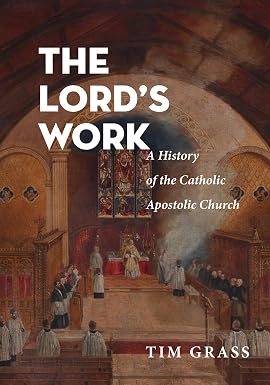
History tends to remember the movements that won. The churches that grew into global denominations, the reformers whose names were carved over doorways. Far fewer readers know the story of a community that set out, in nineteenth-century Britain, to rebuild the church of the New Testament exactly as it had once been — and then accepted, with remarkable calm, that its own season would end.
In The Lord's Work: A History of the Catholic Apostolic Church, historian Tim Grass gives that community the full and careful history it has long deserved. Emerging from the circle around the Scottish preacher Edward Irving in the 1830s, the Catholic Apostolic Church believed that God was restoring the gifts and offices of the earliest Christians: prophets, evangelists and, above all, apostles. Its members expected the return of Christ within their own lifetimes, and they organised their worship, their ministry and their daily lives around that expectation.
What makes Grass's account so compelling is its balance. He neither mocks the movement's ambitions nor romanticises them. Instead, he traces how a small group of earnest believers developed one of the richest liturgies in Protestant Britain, drew in clergy, aristocrats and working families alike, and spread its influence across Europe and beyond — while living with the question that shaped everything: what happens to a church built for the last days when the last days do not arrive on schedule?
Grass writes as a scholar who knows his sources intimately, but also as a reader who first came to church history because he realised the church's story was "a whole lot more interesting than anyone had ever led him to believe." That sense of discovery runs through every chapter. The result is a book that rewards specialists and welcomes curious general readers in equal measure.
Read on Amazon
Meet the author
Tim Grass
Historian of modern Christianity · Fellow of the Royal Historical Society · Visiting Scholar, Queen's University Belfast
Tim Grass is a historian of modern Christianity who lives on the Isle of Man and is a Fellow of the Royal Historical Society. Currently a Visiting Scholar at Queen's University Belfast, he has written a dozen books on church history, with a particular interest in the smaller groups that receive less scholarly attention. His doctoral thesis compared the Brethren and the Catholic Apostolic Church, and he has since written a history of each movement — Gathering to His Name and The Lord's Work — as well as biographies of key figures such as Edward Irving (The Lord's Watchman).
From the editor
Some of the most revealing stories in religious history belong not to the movements that dominated their age, but to those that stood slightly apart from it. The Catholic Apostolic Church is one of those stories, and Tim Grass tells it with patience, fairness and genuine affection for the people involved.
During our recent conversation at The Margin Voice, what struck our team most was Tim's attention to the small details of ordinary life — an instinct he credits in part to his admiration for Jane Austen. That same attentiveness gives The Lord's Work its human warmth. Behind the doctrines and the ceremonies, readers meet real men and women trying to live faithfully in an uncertain world.
For anyone who loves history, faith, or simply a well-told true story, this is a book we are proud to feature.
Why this book matters
Many histories of Victorian Christianity mention the Catholic Apostolic Church only in passing, often as a curiosity attached to the dramatic career of Edward Irving. Tim Grass places the movement at the centre of the frame, showing that it was far more than a footnote. Its experiments in worship, ministry and church order anticipated questions that churches across the world are still asking today.
The book also matters because of the movement's unusual ending. Believing that only the apostles could ordain new ministers, the church allowed its ministry to come to a natural close after its last apostle died at the dawn of the twentieth century. Grass explores this choice with sensitivity, turning what could have been a story of decline into a profound reflection on faithfulness, expectation and letting go.
Finally, The Lord's Work speaks to anyone who has ever tried, as Tim himself once did, to recover the simplicity and vitality of New Testament Christianity. It is both a scholarly achievement and an invitation to think carefully about what it means to build something meant to last.
A journey through the book
- 01
London, 1830s
A preacher, a congregation and a fervent expectation of renewal
- 02
Restored apostles
Twelve men called to lead a church for the last days
- 03
A cathedral of ritual
One of the richest liturgies in Protestant Britain
- 04
Across Europe
A small British movement with an international reach
- 05
The last apostle
Waiting, faithfulness and a church that chose to fade
With deep research, even-handed judgement and a storyteller's eye for human detail, The Lord's Work stands as the definitive history of the Catholic Apostolic Church. Tim Grass succeeds in making a little-known movement feel vivid, relevant and surprisingly moving.
Find Tim's book on AmazonFeatured by The Margin Voice · Curating remarkable books for readers everywhere